

If you’re a chiropractor, you’ve probably noticed one thing over the past few years—patients are searching online before they ever pick up the phone. Whether they’re looking for “chiropractor near me,” “back pain treatment,” or “sports injury chiropractor,” Google has become the first place people go when they need help.
The challenge is that hundreds of chiropractic clinics compete for those same searches. If your website doesn’t appear on the first page of Google, potential patients are likely choosing another practice—even if you offer better care.
That’s where Search Engine Optimization (SEO) comes in.
A well-planned SEO strategy helps your chiropractic website rank higher in Google Search, Google Maps, and AI-powered search results. More visibility means more qualified visitors, more appointment requests, and long-term growth without relying solely on paid advertising.
Unlike Google Ads, SEO continues working around the clock. Every optimized page on your website becomes another opportunity to attract people actively looking for chiropractic care in your area.
Whether you’re opening a new clinic or managing an established practice, this guide will show you how to build an SEO strategy that delivers measurable results.
Why SEO Matters for Chiropractors

The way patients find healthcare providers has changed dramatically.
Years ago, most people relied on recommendations from family members, insurance directories, or local newspapers. Today, Google is the new front door for nearly every local business—including chiropractic clinics.
According to multiple marketing studies, the majority of consumers research healthcare providers online before scheduling an appointment. They compare reviews, read educational articles, check clinic photos, and often visit several websites before making a decision.
That means your online presence directly influences whether someone becomes your next patient.
SEO helps your practice appear when people search for services such as:
- chiropractor near me
- emergency chiropractor
- lower back pain chiropractor
- neck pain treatment
- sciatica chiropractor
- sports injury chiropractor
- family chiropractor
- pediatric chiropractor
- chiropractic adjustment
- spinal decompression therapy
Every one of these searches represents someone actively looking for help.
The higher your website ranks, the more opportunities you have to earn that patient’s trust before they ever contact your office.
How Google Decides Which Chiropractic Websites Rank
Google evaluates hundreds of ranking signals before deciding which websites deserve the top positions.
While no one outside Google knows every ranking factor, years of SEO research have identified several areas that consistently influence rankings.
Helpful Content
Google rewards websites that genuinely answer patients’ questions rather than simply stuffing pages with keywords.
Your content should educate readers about chiropractic care, explain treatment options, answer common concerns, and help visitors make informed healthcare decisions.
Local Relevance
For chiropractors, local SEO is often more important than national SEO.
Google wants to show nearby clinics that serve the searcher’s location.
Your website should clearly mention:
- your city
- neighborhoods
- counties
- nearby communities
- office address
- phone number
- business hours
Experience and Expertise (E-E-A-T)
Healthcare websites fall under Google’s “Your Money or Your Life” (YMYL) category.
Because chiropractic care affects people’s health, Google places greater emphasis on credibility.
Strong signals include:
- chiropractor biographies
- professional licenses
- certifications
- years of experience
- patient testimonials
- citations from trusted medical organizations
Website Performance
A slow website can hurt both rankings and conversions.
Google expects websites to load quickly on mobile devices and provide an excellent user experience.
Improving Core Web Vitals, image optimization, and page speed should be part of every SEO strategy.
Keyword Research for Chiropractors
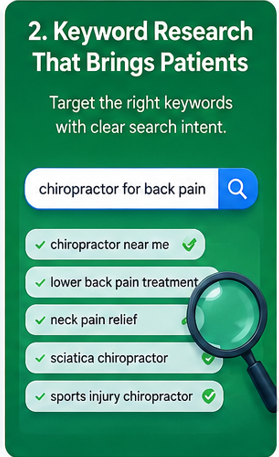
One of the biggest SEO mistakes chiropractic clinics make is targeting only one keyword:
“Chiropractor.”
This keyword is extremely competitive.
Instead, successful clinics target hundreds of related search queries throughout their websites.
For example:
Primary Keywords
- SEO for chiropractors
- chiropractic SEO
- chiropractor SEO services
- chiropractor marketing
- local SEO for chiropractors
Local Keywords
- chiropractor in Charlotte
- chiropractor in Dallas
- chiropractor in Miami
- best chiropractor near me
- chiropractic clinic near me
Service Keywords
- spinal adjustment
- sports injury treatment
- neck pain chiropractor
- lower back pain treatment
- chiropractic adjustment
- posture correction
- scoliosis chiropractor
- sciatica treatment
Informational Keywords
These keywords often bring visitors before they’re ready to book an appointment, helping you build trust through educational content.
Examples include:
- Can a chiropractor help with headaches?
- How many chiropractic sessions do I need?
- Is chiropractic treatment safe?
- What causes lower back pain?
- Does chiropractic care help posture?
Publishing detailed answers to these questions positions your clinic as a trusted resource and increases your chances of appearing in Google’s AI-generated search results.
Build Service Pages Instead of One Generic Page
Many chiropractic websites make the mistake of placing every service on a single page.
A much more effective strategy is to create dedicated pages for each treatment.
Examples include:
- Back Pain Treatment
- Neck Pain Relief
- Sciatica Care
- Sports Injury Rehabilitation
- Prenatal Chiropractic
- Pediatric Chiropractic
- Auto Accident Injuries
- Whiplash Treatment
- Spinal Decompression Therapy
- Posture Correction
Each page should focus on one topic, include unique content, answer patient questions, and explain when someone should seek professional care.
This structure helps search engines better understand your website while giving patients more relevant information.
Create Educational Content That Builds Trust
A blog is one of the most powerful SEO tools for chiropractors.
Instead of publishing random articles, focus on answering the questions your potential patients are already asking.
For example:
- What causes chronic neck pain?
- Is it normal to feel sore after a chiropractic adjustment?
- How can chiropractic care improve posture?
- Exercises to relieve lower back pain.
- When should you see a chiropractor after a car accident?
- Chiropractor vs. physical therapist: Which is right for you?
Educational content not only improves rankings but also establishes your expertise before a patient walks through your door.
For example, if you’re discussing posture improvement or lumbar spine health, you can also recommend this practical guide published on Vocal:
Exercises for Hyperlordosis: How to Remove the Protrusion of the Abdomen and Back Pain
Providing trustworthy educational resources—even from outside your own website—helps build credibility with readers.
Strengthen Your Website with Internal Linking
Internal links help both visitors and search engines discover more of your content.
If you’re building a chiropractic SEO strategy, connect this guide with other educational articles on ExperimentumSEO. For example:
- SEO for Dentists — many local SEO principles also apply to healthcare practices.
- SEO for Landscaping Businesses — demonstrates how service-area businesses can improve local visibility.
- SEO for Garage Door Repair — an example of building location-specific service pages.
- SEO for AI Tools — useful for understanding how AI is changing search and content optimization.
These contextual links improve crawlability, distribute page authority across your website, and encourage readers to explore additional resources.
Google Business Profile: Your Most Powerful Local SEO Tool

If your chiropractic clinic serves patients in a specific city or region, your Google Business Profile (GBP) is just as important as your website.
When someone searches for phrases like:
- chiropractor near me
- chiropractor in Charlotte
- back pain treatment near me
- emergency chiropractor
- chiropractic clinic open today
Google often displays the Local Pack before the traditional organic results. Appearing in these top map listings can dramatically increase phone calls, appointment requests, and website visits.
A fully optimized Google Business Profile helps Google understand who you are, where you operate, and why your clinic deserves to be recommended.
Complete Every Section of Your Profile
Many chiropractic clinics only fill in the basics—name, address, and phone number. That leaves valuable ranking opportunities on the table.
Take the time to complete every available field, including:
- Primary and secondary business categories
- Services and treatments
- Business description
- Office hours
- Holiday hours
- Website URL
- Appointment booking link
- Accepted insurance information
- Accessibility features
- Photos of your clinic and staff
The more complete your profile is, the easier it is for Google to match your practice with relevant local searches.
Keep Your NAP Information Consistent
One of the most overlooked aspects of local SEO is NAP consistency.
NAP stands for:
- Name
- Address
- Phone Number
Your information should be identical across every online directory, including:
- Your website
- Google Business Profile
- Apple Maps
- Bing Places
- Yelp
- Healthgrades
- Local business directories
Even small differences—such as “Suite 200” versus “#200″—can confuse search engines and weaken local trust signals.
Add High-Quality Photos Regularly
Google prefers active business profiles.
Upload fresh photos every month, including:
- Reception area
- Treatment rooms
- Chiropractic equipment
- Staff members
- Community events
- Office exterior
- Parking area
- Team photos
- Before-and-after office renovations
Authentic images build trust and often improve engagement.
Patients are much more likely to contact a clinic when they can see the environment before arriving.
Encourage Patient Reviews

Reviews influence both rankings and conversions.
Think about your own behavior. If you see two chiropractors in the same neighborhood and one has 12 reviews while the other has 320 reviews with a 4.9-star rating, which one are you more likely to choose?
Google pays attention to:
- Review quantity
- Review quality
- Review frequency
- Keyword relevance
- Owner responses
The goal isn’t just to collect reviews—it’s to build an ongoing stream of authentic patient feedback.
Respond to Every Review
Many practices thank patients only for positive reviews.
Instead, respond professionally to every review.
For positive reviews:
- Thank the patient.
- Mention your commitment to quality care.
- Personalize the response when appropriate.
For negative reviews:
- Stay calm and professional.
- Avoid discussing personal health information.
- Invite the reviewer to contact your office directly to resolve the issue.
Thoughtful responses show potential patients that you genuinely care about patient satisfaction.
Local SEO Beyond Google
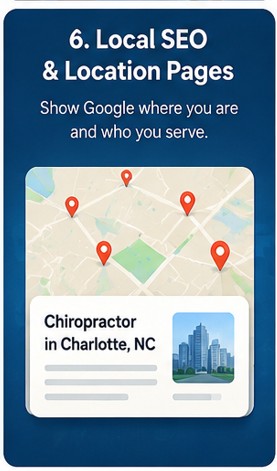
Although Google dominates search, patients also discover chiropractors through many other platforms.
Consider creating and maintaining profiles on:
- Yelp
- Healthgrades
- WebMD
- Bing Places
- Apple Maps
- Better Business Bureau
- Chamber of Commerce directories
- Local healthcare associations
These citations strengthen your online authority and help Google verify your business information.
Create Dedicated Location Pages
Many chiropractors serve multiple cities but only have one generic homepage.
Instead, build optimized landing pages for each service area.
For example:
- Chiropractor in Charlotte
- Chiropractor in Matthews
- Chiropractor in Huntersville
- Chiropractor in Concord
- Chiropractor in Gastonia
Each page should include unique content describing the area, the services offered, and why local patients choose your practice. Avoid simply copying and pasting the same text with a different city name, as Google may treat those pages as duplicate content.
Build Topical Authority with Educational Content

Google increasingly rewards websites that demonstrate deep expertise within a subject rather than publishing isolated articles.
Instead of writing one blog post about back pain, create an interconnected library of content.
Examples include:
Back Pain
- Causes of lower back pain
- Herniated disc symptoms
- Sciatica treatment
- Poor posture and spinal health
- Sleeping positions for back pain
Neck Pain
- Tech neck syndrome
- Whiplash recovery
- Cervical spine exercises
- Pinched nerves
- Ergonomic workstation tips
Sports Injuries
- Running injuries
- Golf-related back pain
- Tennis elbow
- Weightlifting injuries
- Recovery after sports competitions
Wellness
- Healthy posture
- Stretching routines
- Core strengthening
- Workplace ergonomics
- Injury prevention
Together, these articles signal to Google that your website is a comprehensive resource on chiropractic care.
Use Internal Linking Strategically

Internal links are one of the easiest SEO improvements, yet many websites overlook them.
Whenever relevant, connect articles and service pages naturally.
For example, if you’re discussing posture correction, you can reference your article about back pain exercises or a page explaining spinal alignment.
You should also link to related SEO resources on ExperimentumSEO to strengthen your site’s topical authority. Relevant examples include guides on Local SEO, SEO for Dentists, SEO for Garage Door Repair, SEO for Landscaping Businesses, and SEO for AI Tools. These connections help search engines understand the breadth of your expertise while encouraging visitors to explore more of your content.
Optimize for AI Search and Google AI Overviews
Search is evolving rapidly. Many users now receive answers directly from Google’s AI-generated summaries before they ever click on a website.
To improve your chances of being featured:
- Answer questions clearly and directly.
- Use descriptive headings.
- Include concise definitions.
- Support claims with trustworthy sources.
- Demonstrate real expertise.
- Keep your information up to date.
Think of each section as answering one specific patient question. This structure is ideal for both readers and AI systems.
Improve Your Website’s User Experience
SEO isn’t only about rankings—it also affects how visitors interact with your website.
A well-designed chiropractic website should make it easy for patients to find information and book an appointment.
Focus on:
- Fast loading times
- Mobile-friendly design
- Clear navigation
- Readable typography
- Simple appointment forms
- Click-to-call buttons
- Accessible contact information
Small usability improvements can lead to significant increases in appointment requests.
Technical SEO Essentials

Even the best content can struggle if technical issues prevent search engines from crawling and indexing your website effectively.
Review these technical fundamentals regularly:
- Ensure all important pages are indexable.
- Submit an updated XML sitemap.
- Fix broken links and redirect chains.
- Use HTTPS across the entire website.
- Optimize image sizes and file formats.
- Add descriptive alt text to images.
- Implement breadcrumb navigation.
- Improve Core Web Vitals.
- Use canonical tags where appropriate.
- Create a custom 404 page that guides visitors back to useful content.
Technical SEO provides the foundation that allows your content to perform at its best.
Link Building for Chiropractors
Backlinks remain one of Google’s strongest ranking signals.
For chiropractors, the goal is not to build thousands of low-quality links. Instead, focus on earning relevant, trustworthy local and healthcare-related links.
High-value backlink opportunities include:
- Local chambers of commerce
- Community organizations and charities
- Sports clubs and youth leagues
- Local news websites
- Healthcare directories
- University or school partnerships
- Professional chiropractic associations
- Guest articles on health and wellness websites
- Collaborations with physical therapists, fitness coaches, and nutrition professionals
One high-quality local backlink is often worth more than dozens of irrelevant directory links.
Use Community Involvement as an SEO Asset
Many chiropractors already sponsor local events, sports teams, or charity programs. Make sure those activities are visible online.
Ask organizations to link back to your website when they mention your clinic. These local relevance signals can significantly strengthen geographic rankings.
Voice Search Optimization
More patients are using voice assistants to search for healthcare providers.
Voice searches tend to be conversational:
“Who is the best chiropractor near me?”
“Can a chiropractor help with sciatica?”
“Where can I get a chiropractic adjustment today?”
To optimize for voice search:
- Use natural language.
- Create FAQ sections.
- Answer questions in 40–60 words.
- Include location phrases naturally.
- Ensure your phone number and business hours are easy to find.
Add Schema Markup
Schema helps search engines understand your content and can improve rich search results.
Important schema types for chiropractic websites:
- LocalBusiness / MedicalBusiness — clinic name, address, phone number, hours.
- FAQPage — common patient questions.
- Physician / Chiropractor — provider information.
- Review — patient testimonials where permitted.
- Article — blog posts and educational content.
- BreadcrumbList — navigation hierarchy.
Proper schema can increase click-through rates even when rankings stay the same.
Can AI Content Help Chiropractor SEO?
AI can help generate outlines, FAQs, and research summaries, but it should not replace professional review.
For healthcare content:
- Verify medical accuracy.
- Add real clinical experience.
- Include unique insights from your practice.
- Avoid generic, repetitive language.
- Update articles regularly.
Google rewards content that demonstrates genuine expertise and usefulness, not content created merely to publish more pages.
Common Chiropractic SEO Mistakes
Avoid These Costly SEO Mistakes
Even experienced chiropractic clinics can unknowingly make SEO mistakes that limit their online visibility. Avoiding the following issues will put your practice ahead of many competitors.
❌ Targeting Only One Keyword
Many clinics optimize only for “chiropractor.”
Instead, target local and service-specific keywords such as:
- Chiropractor in Charlotte
- Sciatica Treatment
- Sports Injury Chiropractor
- Neck Pain Relief
- Pediatric Chiropractor
❌ Creating Thin Location Pages
Don’t publish nearly identical pages for every city.
Each location page should include:
- Unique local information
- Customized service descriptions
- Nearby landmarks
- Patient testimonials
- Original FAQs
❌ Ignoring Google Business Profile
A neglected Google Business Profile means lost patients.
Make sure you regularly update:
✅ Photos
✅ Services
✅ Business Hours
✅ Posts
✅ Reviews
❌ Buying Low-Quality Backlinks
Cheap backlink packages can hurt your rankings.
Instead, earn links from:
- Local organizations
- Healthcare websites
- Community partners
- Local news publications
- Professional associations
❌ Publishing AI Content Without Human Review
AI is a great assistant—but not a replacement for expertise.
Always:
- Fact-check medical information
- Add personal experience
- Include unique insights
- Update content regularly
❌ Using Only Stock Photos
Patients trust real people.
Show:
- Your office
- Your staff
- Treatment rooms
- Happy patients (with permission)
- Community events
❌ Slow Mobile Website
Most chiropractic searches happen on smartphones.
Improve:
- Page speed
- Core Web Vitals
- Image optimization
- Mobile navigation
❌ Weak Internal Linking
Connect your pages naturally.
For example:
- Neck Pain → Back Pain
- Sciatica → Spinal Decompression
- Posture → Hyperlordosis Exercises
- Local SEO → SEO for Dentists
❌ Not Tracking Conversions
Traffic alone doesn’t grow a practice.
Measure:
- Phone calls
- Appointment requests
- Contact forms
- Direction requests
- Online bookings
❌ Giving Up Too Soon
SEO is not a one-time project.
The most successful chiropractic websites continue improving month after month.
Remember: SEO is a long-term investment. Consistent improvements almost always outperform short bursts of optimization.
How to Measure SEO Success
Ranking on Google is exciting—but rankings alone don’t pay the bills.
The real goal is attracting qualified patients who schedule appointments.
| KPI | Goal |
|---|---|
| 📈 Organic Traffic | +40% |
| 📞 Calls from Organic Search | +25% |
| 📅 Appointment Requests | +18% |
| 📍 Google Maps Rankings | Top 3 Local Pack |
| 🖱️ Organic CTR | +12% |
| ⭐ New Reviews | 50+ per year |
| 💰 Cost per Acquisition | 30% Lower than Paid Ads |
Track your performance using:
✅ Google Analytics 4
✅ Google Search Console
✅ Google Business Profile Insights
✅ Call Tracking Software
✅ Heatmaps (Microsoft Clarity or Hotjar)
Review these metrics monthly to identify what’s working and where improvements are needed.
2026 Chiropractor SEO Checklist
Before publishing or updating your website, use this checklist to make sure your SEO foundation is complete.
Local SEO
☐ Fully optimized Google Business Profile
☐ Consistent NAP across every directory
☐ Google Maps optimization
☐ Local citations updated
☐ Fresh Google reviews coming in regularly
Website Optimization
☐ Dedicated service pages
☐ Unique location pages
☐ Fast mobile performance
☐ HTTPS enabled
☐ XML sitemap submitted
☐ Optimized images with ALT text
Content Strategy
☐ Helpful educational blog posts
☐ Internal links between related pages
☐ Updated articles every quarter
☐ AI Overview optimization
☐ Voice Search FAQs
☐ E-E-A-T signals throughout the website
Authority Building
☐ High-quality local backlinks
☐ Community partnerships
☐ Healthcare directory listings
☐ Positive online reputation
Performance Tracking
☐ Google Analytics configured
☐ Search Console connected
☐ Conversion tracking enabled
☐ Phone call tracking
☐ Monthly SEO reporting
⭐ Pro Tip
Instead of trying to complete everything at once, improve one area every week. Small, consistent updates compound over time and often lead to significantly better rankings, increased traffic, and more appointment requests.
Frequently Asked Questions
How long does SEO take for a chiropractic practice?
Most clinics begin seeing meaningful improvements in 3–6 months, while highly competitive markets may require 6–12 months for strong first-page rankings.
Is local SEO more important than national SEO?
For most chiropractors, yes. The majority of patients come from nearby communities, so ranking in Google Maps and local search results is usually the highest priority.
How many blog posts should a chiropractic clinic publish?
A practical goal is 2–4 high-quality articles per month. Consistency matters more than volume.
Do reviews help SEO?
Absolutely. Reviews are a significant local ranking signal and also improve conversion rates by building trust with prospective patients.
Can a new chiropractic website rank on Google?
Yes. New websites can compete effectively by targeting local and long-tail keywords, building strong content, and earning quality local citations and backlinks.
Should chiropractors use AI-generated content?
AI can assist with research and drafting, but all healthcare content should be reviewed by a qualified professional before publication.
Final Thoughts
SEO for chiropractors is no longer optional—it is one of the most reliable ways to attract new patients in 2026.
The practices that win online are not necessarily the largest clinics. They are the clinics that:
- answer patient questions clearly,
- demonstrate genuine expertise,
- optimize their local presence,
- earn strong reviews,
- publish helpful content consistently,
- and make it easy for patients to contact them.
Start with your Google Business Profile, build dedicated service pages, create educational content around the conditions you treat, and connect everything through smart internal linking.
Over time, those individual improvements compound into stronger rankings, more qualified traffic, and a steady stream of new patient inquiries.
For additional SEO strategies, explore the educational resources available on ExperimentumSEO Blog and continue building your practice’s online authority one optimized page at a time.